About'Me

  • Full interview between Ayn Rand and Playboy can be found here: http://ellensplace.net/ar_pboy.html.

    PLAYBOY: Couldn't the attempt to rule whim out of life, to act in a totally rational fashion, be viewed as conducive to a juiceless, joyless kind of existence?

    RAND: I truly must say that I don't know what you are talking about. Let's define our terms. Reason is [a person]'s tool of knowledge, the faculty that enables [zem] to perceive the facts of reality. To act rationally means to act in accordance with the facts of reality. Emotions are not tools of cognition. What you feel tells you nothing about the facts; it merely tells you something about your estimate of the facts. Emotions are the result of your value judgments; they are caused by your basic premises, which you may hold consciously or subconsciously, which may be right or wrong. A whim is an emotion whose cause you neither know nor care to discover. Now what does it mean, to act on whim? It means that a [person] acts like a zombi, without any knowledge of what [ze] deals with, what [ze] wants to accomplish, or what motivates [zem]. It means that a [person] acts in a state of temporary insanity. Is this what you call juicy or colorful? I think the only juice that can come out of such a situation is blood. To act against the facts of reality can result only in destruction.

    PLAYBOY: Should one ignore emotions altogether, rule them out of one's life entirely?

    RAND: Of course not. One should merely keep them in their place. An emotion is an automatic response, an automatic effect of [a person]'s value premises. An effect, not a cause. There is no necessary clash, no dichotomy between [a person]'s reason and [zir] emotions -- provided [ze] observes their proper relationship. A rational [person] knows -- or makes it a point to discover -- the source of [zir] emotions, the basic premises from which they come; if [zir] premises are wrong, [ze] corrects them. [Ze] never acts on emotions for which [ze] cannot account, the meaning of which [ze] does not understand. In appraising a situation, [ze] knows why [ze] reacts as [ze] does and whether [ze] is right. [Ze] has no inner conflicts, [zir] mind and [zir] emotions are integrated, [zir] consciousness is in perfect harmony. [Zir] emotions are not [zir] enemies, they are [zir] means of enjoying life. But they are not [zir] guide; the guide is [zir] mind. This relationship cannot be reversed, however. If a [person] takes [zir] emotions as the cause and [zir] mind as their passive effect, if [ze] is guided by [zir] emotions and uses [zir] mind only to rationalize or justify them somehow -- then [ze] is acting immorally, [ze] is condemning [zem]self to misery, failure, defeat, and [ze] will achieve nothing but destruction -- [zir] own and that of others.

    This is probably the only position that I agree in entirety with Ayn Rand on.

    My brother had found the above interview and, upon reading it, handed it off to me (it's nice, in part, to have a sibling still in college, because then the rigorous consumption of intellectualism doesn't have to end just because I'm out of college, though I think it has more to do with his own obsessive intelligence).

    And it's a fascinating read; Ayn Rand certainly is very intelligent (or, at the very least, has a masterful command of communication). And yet (as I expected I would), I find myself disagreeing – in at least complete terms – with most of her.

    The obvious point of contention I'm going to have is with her assessment of literature (which, if I'm to be fully frank, I find rubbish), though I think the reason for this lies in that, while I believe I've said before – and do partially agree with her – that literature ought to (namely, in this case, regarding morality) make an arguable point, I don't think the writer (or the reader) has to necessarily agree with it. I do fall into the camp that believes that, the more ideas we're exposed to, the better we are off and that all thoughts and concepts should be examined in full. And, in particular when it comes to literature, there is importance in the craft of making you feel for, and to understand the motives of, characters you don't agree with.

    But this is mostly an aside, since, at the end of the day, I certainly have no interest in drawing sides based around personal tastes in literature. I disagree with Ayn Rand but would feel no compulsion to dissway her of her opinions, if she had no interest of changing them (and it's completely fair that she would likely find my own thoughts on literature to be rubbish as well).


    Rather, the larger points of contention that I have is Rand's conception of the proper use of government:

    PLAYBOY: What, in your view, is the proper function of a government?

    RAND: Basically, there is really only one proper function: the protection of individual rights. Since rights can be violated only by physical force, and by certain derivatives of physical force, the proper function of government is to protect [people] from those who initiate the use of physical force: from those who are criminals. Force, in a free society, may be used only in retaliation and only against those who initiate its use. This is the proper task of government: to serve as a policeman who protects [people] from the use of force.

    To my knowledge, Rand never states the reason for avoiding the use of force against other citizens, but I'm going to make an assumption and assume that it's because the use of force to overpower another is a negation of their freedom.

    The point where we severe agreement is that I would argue that force is not the only power that may negate another's freedom. I'd first bring up (which Rand may or may not agree with me on) that people require, at least from the start, proper education in order to properly assess the world (using her own conceptualization of the world: a person is not born understanding the world; thus, they are emotional. As such, they blunder through the world incapable of learning from it, possibly to never reach the understanding that they must use reason to comprehend it. As such, an education that makes clear to a person the use of reason and logic is necessary to make sane and safe people).

    It is a lack of this necessary education that allows for people to become (and remain mired in) racism. And it is this racism, on a large-scale, that enabled Jim Crow. Of course, one might respond back that this is why we need limited government. To which then I would appeal to the housing crisis during and following the African American Great Migration for the south to the north, during which real estate sellers would purposefully over price tenement- and slum-like conditions to African Americans and ensure that the African Americans could not receive housing in any white neighborhood. This wasn't an instance of legalized racism (which is why the Civil Rights Movement in the 60s failed in their attempt to combat racism in the north); this was individuals making racist choices (so much for "[...]there is no such thing as society. There are individual men and women[...].").

    And those individuals tried to do something about it (again, civil rights movement); the top five most segregated cities in America all maintain a dissimilarity index in the high 70s to this day.

    So, to recap, the fundamental difference I have with Rand on this point is that physical force is not the only force capable of being wielded against individuals. And, as such, I fully and fundamentally believe the government should protect against this.

    But perhaps another flaw is that Rand believes that laissez-faire capitalism works, whereas I (again fundamentally) do not.

    And I think these two points can be, once again, summed up in a fundamental difference in view that I have with Rand: she (as well as libertarians and anarchists), to some degree, believes people can be trusted (this is applicable with the phrase "to some degree" because, even if you think complete freedom enables a constantly vigilant and self-sufficient person to resist those who might attack him, this trusts that those who might find more advantage in overpowering you will be unable to (or that you can outwit them); and, for those who would appeal to others out of those others fearing for their own rights at the hand of the amassing mob, you are trusting that those individuals will be intelligent enough to understand that concept – Nazi Germany would seem to disagree with you).


    This was more or less the point that I came to with my cousin when discussing whether she felt the FDA ought to be struck down. She felt it ought to be and that there were alternatives to it through privatized means. Incredulous, I asked how she could trust what was to go into her stomach with privatized forces, to which she pointed out, "There's our difference; I don't distrust people." Does anyone know why your health listing of food says Dietary Fiber rather than just Fiber?

    Because that's the base of it: the market will not respond in what's best for people; the market responds with what's best for the market. If someone can make a profit selling bread with sawdust in it rather than simply selling a quality product, they often will do it. If dolls of Stalin as an adorable humanitarian become popular, the market will mass-produce them in full-force.  Forget the fact that it's glorifying a mass-murder.

    And while there may be an outcry against sawdust bread, there is the requirement that every individual remain vigilant against such things so that they don't happen once again, which may be difficult if you live in a tenement in Chicago and can't leave because people 6 decades ago constructed it as an economic trap to make sure you could never enter their neighborhood.

    The very reason the American government is a republic instead of a democracy was out of distrust of people as a mass-group, to allow representation of minority opinions instead of mob-rule by the majority.

    And, for all the obsession with freedom and liberty, there can be neither freedom nor liberty in any system which allows the control (either through physical force or psychological force of society) of others by others.


    And I think, ultimately, this is why I must part with Rand: her societal ideas are, ultimately, based in ideal rather than what is practically realistic, much like communism.

  • I'd always heard the Benjamin Franklin quote as, "He who sacrifices freedom for security deserves neither," to which my response was always, "What liberty is there without safety?"

    The actual quote I find far more advisable: "Those who would give up Essential Liberty to purchase a little Temporary Safety, deserve neither Liberty nor Safety."

  • Because I find it useful to keep track of my progression over the years:

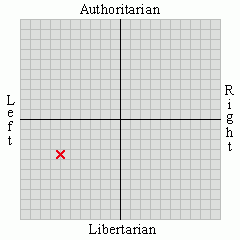
    The Political Compass

    Economic Left/Right: -3.12
    Social Libertarian/Authoritarian: -3.95


    For a different one that I took as well:

    Compass:

    You are a left social libertarian.
    Left: 6.12, Libertarian: 3.54


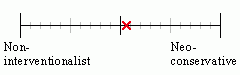
    Foreign Policy:

    On the left side are pacifists and anti-war activists. On the right side are those who want a strong military that intervenes around the world. You scored: 0.54

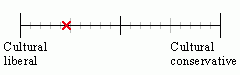
    Culture:

    Where are you in the culture war? On the liberal side, or the conservative side? This scale may apply more to the US than other countries. You scored: -5.48

     This one in particular is interesting because I took it back in 2009 (http://thirst2.xanga.com/714123084/item/). I've gone a lot further to the liberal in those two years, it seems: from center-left moderate to flat out left (which, while it makes sense, I would never have admitted back then; like I've said, I liked to think I was more liberal that I honestly was back then).


    Aaaand another:

    Quiz Results

    The RED DOT on the Chart shows where you fit on the political map.

    70_20

    Your PERSONAL issues Score is 70%

    Your ECONOMIC issues Score is 20%

    According to your answers, the political group that agrees with you most is...


    Liberals usually embrace freedom of choice in personal matters, but tend to support significant government control of the economy. They generally support a government-funded "safety net" to help the disadvantaged, and advocate strict regulation of business. Liberals tend to favor environmental regulations, defend civil liberties and free expression, support government action to promote equality, and tolerate diverse lifestyles.


  • I'm pretty sure the only times I feel fully like something isn't missing is when I have some dedicated purpose or doing activism. Which is clearly problematic on a whole scale of levels.

    I wanted a quiet Senior year to not get overwhelmed and sort of find some mental peace and figure things out.

    Well, fuck it, then.

  • While only 21-years-old (22 in Nov.), I like to think I've seen a lot. At least for being 21. I've seen death; seen even more (than I've ever wanted to see) near-death experiences. Had my own share. Seen love; multiple times. Had my own slew of breath-taking experiences. Been moved. Et cetera and so forth. And likely have no idea what else I'll get to learn or discover that I never could have fathomed before then.

    And I don't think I want to say this is one of the most arresting experience I've had (besides, when have I ever been decisive?). But petting my pet rat and him bruxing happily and then grooming my hand voluntarily on his own after more than half-a-year of trying to get him to trust me is honestly one of the most moving things I've ever experienced.

  • I know that one of the first reactions to my current state will be why I didn't try more (I forget if I've written on any of it as of late; I tend to be very careful about what I admit to going on in my head).

    An old entry-mate of mine let me know I was invited to a small party a lot of the Jewish kids on campus were going to be having at his dorm. I was very appreciative. This was largely because I hadn't been very close with my entry and it was a direct addressment, something I seem incapable of deriving in simple eye contact and conversation with most people. I appreciated being acknowledged and, because I was very fond of all of my entry regardless of how close we wound up being, that it was by an old entry-mate.

    I doubt I'll be going. And the first thing people will point to as to why I find myself so systematically pushed down is that I didn't bother to push back.

    What they fail to realize is that I suck at socializing with those I'm not close with; I've mentioned a million times so I'll leave it at that. I also take and analyze everything. I still flinch in public when an embarrassing/bad memory suddenly pops into my head. What might be mild embarrassment for one moment in the past will be assessed over and over until that embarrassment is certain to be remembered quite vividly well.

    If I were someone who could act because they didn't care the consequences, there's much I could do. Bad situations would simply be memories, and I'd be confident enough to get enough successful public interactions.

    But that is not me. And, while the criticizer could respond that it's only through trying that progress is made, I do not know that my chosen moment of bravery will be successful. Many might not be. Which means a great deal of emotional strain in order to incur only more. At the end, choosing simply not to interact or try to get a person to willingly engage me in conversation might not have a satisfactory goal, but it doesn't inflict inane suffering.


    Upon leaving Shabbat dinner, I saw Kim. Happy to see her, I snuck up and gave her a hug, wanting to mask my own loneliness and, if possible, fill it in with my appreciation of her and any others to which I have attachment (getting to spend most of today with WSCers made this a good day).

    I find the sentiment of healthiness funny. It means whether in shape, or whether breathing correctly, or if your hair is all there, or if your muscles work well, usually. It is all physical measurement.

    Depression is to be continually sick, to never be rid of sickness. Like an STD for which there is no cure, there may be some days it doesn't itch, though it lightly throbs with soreness. And then other days it rears red with inflammation and more discharge than you want anything to do with.

    It is your parasite some days, in some ways your friend others. Yet maybe all only because it is always there.


    There is a proverb that goes, "And this too shall pass..." I being me, I always took this with more murky a tone than its supposed polar capability. Certainly in the sight of joy, it is a wistful reminder that it shall not stay. But even in hardship, it's said with the tone that implies a sort of acceptance. It shall pass because that is nature and, by nature, it shall come again, so that you shoulder it reveling the pain it inflicts since this is your normalcy and you yearn to feel.

    Yet I find this dichotomy interesting in light of a scenario that doesn't even allow its duality.

  • You know, I'd appreciate not being continually told that asserting myself or dominating others is what makes me a man. My masculinity exists for my personal comfort and adjustment, not your gauge of acceptability nor verification of my genitals.

  • Note: I wrote this 24 hours ago, but was only able to reach internet to post it until now.


    Long time readers will remember that I attempted the Überman sleep schedule sometime roughly around last year. After one of my posts, I simply ceased mentioning it, not mentioning whether I failed, decided I didn't like it, or succeeded.

    I had intended to give a quick detail, but I was in the middle of my semester at the time. And my temperance has become more and more a slave to tempering my mood these past few years, as I've mentioned before.

    I forget if I mentioned it them but, while others tend to feel immense tiredness during the process, I didn't have that problem as much. But I've noticed, as I've played with sleep deprivation more and more these past three years, that I seem to be able to handle myself without sleep shockingly well (even when I anticipate there being a problem). The main problem was the same problem I've always suffered with: not staying up but waking up.

    Every so often I'd wind up oversleeping my alarm and, interestingly, wake up three hours later on the dot. Notably, I think such a pattern might fit in with the Everyman-3 schedule, which shocks me since I have skepticism of anything between a siesta sleep schedule and the Überman. Regardless, not only was such oversleeping problematic (I overslept two of my classes during that time), it was reduntantly pointless; overshooting my naps was not going to break me into the Überman, only provide a slightly uncontrollable sleep schedule that didn't yield the same clarity and lack of exhaustion that I could more often achieve on a monophasic sleep schedule (in retrospect, it's interesting to note that one of the reasons I ditched monophasic sleep was that it was, for me, disgustingly bloated and kept me feeling groggy every time I first woke up. The only time I actually seemed coherently energized to my fullest was when nighttime hit, so maybe I didn't actually lose anything during my polyphasic sleeping given that I was tired in both cases and my appetite for 12+ hour naps isn't exactly the definition of control either).

    Given this situation, I decided to ditch the schedule given my certainty I would need a partner to even reach a point where I could finally determine if this thing was even possible, considering my inability to wake myself. No one at school was going to sign on to that.


    Recently, I decided to rescind this decision. Notably, the smart decision would have been to start trying to accomplish this before three (going on two now) weeks until I go back to school. But I suppose it gives some slight comfort to know that jumping into things and discovering what can go wrong along the way is an impulse which hasn't died entirely in me yet.

    However, there are other reasons why I need to do this. Once again, the amount of time I'd gain from only getting 3 to 2 hours of sleep per day are unspeakable. Particularly in the advent of upcoming school? I'm pretty certain that I couldn't have gotten done first semester last year had I not been operating on the Überman. It just opened up so much more time.

    Which, of course, beats my need for over 12 hours of sleep (something continually set back until the weekend each week as I must wake up for class each day)…only to wake up groggy and, half the time, sore (not to mention the weakening of back muscles).

    However, more than anything, my depression needed it. If you've read my xanga from its very beginning, one of the things I've continually lamented is – at times – a seeming slip in control. At first it was emotions and, I think (funny, no?), memory. Recently it's simply been life. For the past 2 months straight, I've been bogged by a consistant depression. As in, it has not lifted. There was no change, alteration, or simple peace for the past two months. It's like hitting a rut and just staying at that low.

    Add to that lack of control my sleep schedule (plus the depression at times). I missed Easter Mass simply because I could not get out of bed. Muscles were working fine, but the brain seemed terrified by the very notion. I stayed in bed for 24 hours that day because of a combination of depression, anxiety, and exhaustion. And, of course, these things feed on each other. Stress and depression make you tired. Being incapable of making arrangements with friends makes you bitter, feeding the depression. And, above all, a feeling of lacking control is not something I can tolerate.

    I can put up with people, most days. I can put up with everyone disagreeing with me or even the stupidity that humanity (particular en masse) can exhibit. But I need control. Part of why I can stick by what I say, think, and do is because I know backwards and forwards why I do it. I believe in it. I can back it. That's all I need to know. As long as I know I'm in control of what I'm doing and have a grasp on my surroundings, I'm okay. Being thrown into a new environment (college) and reliving just how socially awkward I am and incapable of doing things when uncertain of myself (mark that with being sociable in general) obviously doesn't help this. Adding depression and an inability to get out of bed? That's too much.

    These past two months I've been drifting, more so than even I would want to. I've been distant, I've not bothered to instigate meeting up with people, and I've been beyond my usual un-initiating distant that I usually have with people. Sure, I've always maintained that I friend more extroverted and outgoing people because I need people who will remind me to meet up and keep in touch. But I've fallen behind in nearly all correspondences I've even started. I flat out missed meeting up with Allen this summer. I still have a slew of FB catch ups I need to respond to (including catching up with Emily Lin, for fuck's sake!). I've avoided IM to avoid talking to people. I've just been distant, too thoroughly comfortable with isolating myself like this. I have duties, such as working on Williams Catholic and the Moocow band's websites. But no.

    As I've said before, I need purpose, and I need direction. For whatever reason, I lack at the moment. Since starting to try to jump into polyphasic sleeping again, I've broken that depression after two months; I have a goal, and I'm actually trying to accomplish it. Part of it too is, again, how my mood is affected. Having less time in a day exacerbates a feeling of being unable to do anything, which worsens my depression, which worsens my ability to do any of of the simple tasks in the paragraph above.

    I need all hours of the day. I work in the night, when it's peacefully beautiful, and I can be alone. The morning, again beautiful, lets me rejuvenate. The day is generally dedicated to everyone else's needs (work, club responsibilities, shopping, etc.). Remove one of these and I don't have enough time. And my depression makes doing anything that belongs during a different time of the day grating because, simply, my depression doesn't want to do it (aren't mood swings fun?).


    As to the drawbacks, I've never quite understood them. Sure, you have 6 half hour naps placed throughout the day. But they're only 30 minutes. I don't drink, as it is, so I don't have to worry about it crashing my drinking. If I was staying up, I can't imagine anyone I would hang out with would really be bothered by it. Further, if you're staying out for, say, 6 hours – you only miss a half hour of it. Plus, you can nap anywhere (if how they describe your reaction to the schedule is correct). And all the other benefits completely sideline this.

    Further, I've already said I handle sleep deprivation fine. I already have to stay up to make up all the responsibilities I have to get done usually, so why the Hell not. Lastly, I have depression – living is a health concern. I get more stress than I normally should. Like I've said before on here, I will be shocked if I don't get type II diabetes by age 25. Shocking me in terms of everything I know about how I treat my body already, the doctor has told me the only thing wrong with me is my good cholesterol (it's scarily low) – so why not free up some time to do the exercise I need to fix that? Lastly – I'm young. And clearly my depression is the only one in favor of doing anything slowly, burning out like a candle.

    And, like I've said before, death just doesn't scare me. Not that I don't think it's around the corner (everyday I feel like I could grab it and put it in my own hands, actually) – my quarter life crisis should make that one clear. If anything, I feel far older than I know I have any right to feel. I just…don't give a damn; and, really, this is the best choice. I need this.

    I've kept oversleeping the first two days. I thought I found a fool-proof method by using headphones so that the alarm would shock me awake, but I would up sleeping through it for an hour and a half past my wake-time this morning at 8 (which probably wasn't any good for my ears, either…). I don't want to give up yet, though. If I can get past the first two, maybe three, days, I think I'll be golden. We'll see.


    Earlier in the summer, I met up with Victoria and Laura. I forget the surrounding discussion but, at some point, Victoria mentions that Michelle and I should happen as a couple. This was, if my memory serves, shortly after Jeff's graduation party, during which Michelle and I wound up shoving cake down each other's clothes, make snide remarks at each other the entire time, and wound up watching the movie Jeff wanted to show us with me sitting on top of her the entire time (at first in an attempt to annoy her, then not bothering to move because apparently the pressure wound up helping some sore muscle). So, admittedly, I can see where she might've gotten the idea.

    Regardless, I immediately told her no (I think my exact response might've been cocking my eyebrow and asking, "Why?"). I told her, for one, that I had a strong feeling that Michelle would say no right out the gate. And, even if that wasn't the case, Michelle and I – I think, at least – wouldn't be a good match. If she was also interested, sure, why the Hell not. But there isn't enough incentive for me to go out on that limb as things stood. Neither of us were so let's leave it at that.

    Yesterday (alright, two days ago technically), I came across Michelle's OKCupid account. And I still have no idea what the Hell happened. I was amused and messaged her, both of us bantering as usual. And then…I started looking at her differently. And, again, I have no idea why. I don't know what exactly changed at that point from the other 5 years of our friendship, let alone the time between talking to Victoria and now.

    So, it seems I've got a crush – which even I can admit is irresponsible and unwise. Why?

    First and foremost, as I said before, Michelle and I don't really make matches for each other. While not a comment on it's supposed accuracy, even OKCupid ranks our chances of being a match at only a 67%. Yeah, I know, people don't have to match up on everything to be a fit but – in my case – they tend to have to.

    I don't think I'd describe Michelle as a distant person; we've had serious moments in our friendship where we've really connected, though we haven't spent much time at all expanding that (though, admittedly, I realize now that our friendship hasn't been developed in a lot of ways, which is why we tend to stay on the annoying each other waveline most of the time). That said, though, Michelle even says in her profile that there needs to be a fair level of teasing in the relationship (if Larry was any indication, nothing too different that Michelle and I's friendship right now). And she at least says and puts on a higher self-esteem by far than me (though I do have slight reservations on that assessment). While I seem to be drawn to those with at least a somewhat extrovert personality, I like (really, need) someone with a fair dosage of insecurity, in part to balance my own and in part for other reasons I've listed out here in the past. Laura, jess, and Allison are all perfect examples of this.

    Because, while clearly I can have an animated personality and my xanga is a perfect example I can be tersely caustic and raise a little Hell, I'm more often…not. I'm an introvert at heart, and I like myself that way. But, more pertinent to the point we're discussing (and as I said before), I'm insecure. I'm hesitant. I'm, all too often, severely emotional. I have a habit of taking care of others and need to be close to people. And – more than anything – if you're looking for someone wholly independent, I'm not. I've got baggage, a good 15 years of it.

    Of course, I could be wrong. Our personalities might mesh just fine. But, from my very limited view, it seems to me that what we would want and need out of a relationship would vary too greatly for us to work long term.

    There's also the timing of the stupid thing. Two weeks before I go back to school, I remind. While, actually, I might be more willing to do long distance with her while I explicitly didn't go chasing after other people for that very reason, distance was the splitter for her and Larry. While it seems she might've burned out her need to kinda run freely (again, me guessing), I wouldn't want to launch into something as restrictive as long distance can be on her, especially when that's the opposite of what she wanted out of college to begin with.

    Then there's also the fact I've had a crush on Margaret since before she went abroad – and I've been waiting for a semester and a summer until she came back. Of course, while to not the same degree as Michelle and for different reasons, I have a suspicion that Margaret and I aren't quite a perfect fit either. But I know too well what fruits come from constant hesitation. Besides, not like anyone else at Williams has caused me to linger for so long.

    But, the overall block that makes any other consideration superfluous is that I'm pretty certain that, even if I asked Michelle out, she'd say no.

    And, while I don't really have anything to give evidence that Michelle would do this (and, hence, will not bother to contemplate if such is the case), this whole conversation highlights in my mind a trend I've been noticing with just about anyone I've had an interest in or who has thrown a bit of interest towards me since Laura.

    It goes along the line of, "You're a really nice guy and very sweet, etc. but…"

    not good enough.

    There is something which just holds the person back, makes them willing to pass over me. Now, I know I'm not usually in the habit of building myself up, unless it's clearly joking hyperbole. Excluding a few particular traits, I'm usually willing to find fault. That said…I'm not that bad of a guy.

    I'm nice and you basically have every guarantee I'm not going to cheat or deliberately hurt you; any person who's known me since Sophomore year of high school knows that one. I've worked for it; I've been very loud and public about the need to make sure others are alright – there's a reason that's how most of my friends describe me, there's a reason people I've met tend to wind up confiding in me more or coming for advice.

    I'm patient; I'm understanding. I'm compassionate. Apparently there's a decent contingent of people who even find me funny.

    And, no, even I wouldn't call myself the best catch out there. If you want confidence, probably not best to make me your first choice. I'm eternally awkward in oh so many ways. And, sure, you have to put up with my many high principles; I've got my fair share of what people might call odd habits. I don't fit mainstream appeal, sure.

    But if you're asking me to shave, or "do something" with my beard, I have to wonder if you're even acknowledging me.

    I've always been very loud about my feelings toward physical appearance. I've written on the subject here God knows how many times. I'll run your ear on the subject if you let me. I actively am particular with my language on account of it and am quick to explain it if you ask me a question along its lines. It's kinda my hallmark crusade, other than Queer rights. It's what I've come to be known for, for some people.

    So I cannot understand people who continually ask me if I'm going to shave it, or ask over and over it again why it's a big deal. It's like asking a religious person, "Oh, I know this means a lot to you but could you please urinate on your holy text, for me?" This is one of the central tenets of my ideals. Like, it's very fundamental reason for existence is based on how I feel you should treat others – you remove or violate this and you basically stab everything I hold dear. There's no reason for me to give a damn about anyone else. I mean, I usually like to think there is no one out there as bad as my mother but you operate with the fundamental stupidity she seems to possess when you do this. Because she asks if I'm willing to shave, I explain the whole point of it all, then she asks, "Well, how about we just trim it? See, it won't be that much." And then I explain it again, and we repeat this process indefinitely.

    How little it is isn't the point.

    And her complete inability to use basic logic to take my explanation and understand why I refuse demonstrates her limited intelligence – people give a complete damn about their appearance, everyone. It can't even enter her head otherwise. And, the mainstream and majority of people she meets do as well. So it must be true. Therefore, it doesn't matter what I say. In her mind, the reason I refuse is because of how much hair I'm cutting. Because, from her mindset, this is the only piece that fits.

    And that is the brain-dead intelligence you wield when you ask me the same question.

    But more importantly, I can't remember if I've discussed point of view on here much. People's inability to see things from other people's point of view is one of my biggest complaints. It would resolve a lot of misunderstandings and hurt feelings, for one. But, two, it doesn't seem like such a difficult ability to me; yet it seems to be.

    But I'm fascinated by other's point of view. My obsession with the human personality (and, thus, a person's life experiences) fascinate me. I'm willing to try to understand where someone is coming from. I might not agree with them in the end. But I'm interested. Notice that I've described here a willingness to date a person if they also show interest (admittedly, as Dodi once said, someone liking me can often go a long way in having me like them). I might be hesitant to try it otherwise, but I'd certainly be willing to try it out if they're interested in me.

    I'm willing to give it a chance.

    It just seems to be that no one is really interested in even bothering to consider what I hold dear and what I find to be amazing. I mean, sure, if it was something like archaeology and no one else found it interesting (not that no one would date me because I like it, because that'd just be stupid of people), I would say, "Fine, fair." And this is not me asking rando number 3 off the street, either. This is, for one example, Monica, someone I've known for years now, someone (of all people) who should know my politics by now. Yet the very most fundamental aspect of me, the one to which – I would argue – you have to understand in order to understand me, comes with an "Well, if…" criteria.

    Once again, as if no one quite gives a damn; as if my very principles (and cares) are negotiable and excusable as far as the world is concerned.

    I just feel alone.


    J: If I were a fermata, would you hold me? 

        Btw, I'm sensitive and you have a habit for teasing, it seems. Do you think that could feasibly be a problem??

    M: With a beard like that, NOTHING is a problem. But I'm going to have to call you ducky. Do you like purple drink?

    J: Haha, well, I think ducky is a small concession in comparison to that *last* question. But you're too tempting for me to resist, my belle Juive.

    M: There is no way you could handel me, ever. But nice try. I am faster better stronger smarter prettier and I win more. You will never beat me. NEVER, I SAY!

    J: Who said anything about beating you?! That's completely a fabricated stereotype about black males in relationships, you must know that!

        However, it seems you're issuing me a challenge. And I can be quite stubborn on principle.

    M: You know what, Jawn? Suck. My. Cock.

        While you're at it, order me a pizza and tell me I'm pretty.

    J: Oooh, I love it when you talk dirty.

        And have I ever told you how you always just seem to glow? Your graciousness and joyous nature inspires everyone in the room. It's no wonder they hang on your every word. Aphrodite herself would blush deeply red in jealousy of the way your eyes catch the light, or the coaxing passion of your smile. You are radiant, m'dear.

    M: Why thank you, vagina face. I love you, too. YOU NEED TO HANG OUT WITH US BEFORE YOU GO BACK TO SCHOOL, YOU ASSHAT D:<

        I miss being mean to you ):
     

  • For at least the past four years I've said that a likely needed criteria for any future partner would be that the individual have depression. While Laura actually wound up disagreeing with me, I've kinda felt like someone who hasn't suffered some large traumatic experience or dealt with long-term depression wouldn't quite understand, well, me.

    See, I had thought of this situation one time that, without any rational experience, made so much intuitive sense that I'm willing to stick by it. As if I experienced it myself, I guess. Basically, I feel that if I came to someone who hasn't had depression (or something similar), they would approach it like they need to fix it – which makes sense.

    Except (at least clinical) depression never goes away (or it's very rare). And, you know, being anti-social or wanting to pull away are things that will be constant. I don't know how to explain that listlessness that's all too common. Or how you even support that. And I just see that person becoming irritated over time.

    Yet someone who either has depression as well or knows it well enough would, simply, understand that situation. In a way that you could only understand if you've experienced it, they'd understand that you're not going to "solve" it, ever; you have to deal with it differently.

    Honestly, that's why I surround myself with people with depression, ED, SI, or any other mental disorder. I might say we're all people intimately acquainted with addiction, but I don't feel I'd find the same connection with an alcoholic (though that might just be my own ignorance).

    The point is, I feel more at home with them. We see the world differently, see things the world doesn't – they make more sense to me. And I'm not certain I'd be able to truly deal with my own depression without that connection. Because it's not going to be solved because it'll never go away – it needs to be understood, something so ingrained and intertwined into yourself, so attuned to your emotions.


    I enjoy hanging out with my siblings because sometimes it allows for those singular moments that I can escape to that aren't open in nearly any other facet of society. Sometimes it's just crass humor (or laughing at things because they're so odd or unconventional from the normal "social" means of behaving) to those moments where I'm reminded just how similar and in line in thought we are.

    My brother and I are in the basement around 9:30 P. M. and the dog's sleeping on my sleeping back with us. As my brother picks up some of his dishes to bring upstairs, he asks me, "Think we should put him in his cage for the night?"

    I respond, "Naw, wait 'til mom or dad yells at us. He's sleeping now, and I'd rather keep him by us."

    My brother goes, "Yeah, just 'cause…" and then hesitates before finishing with, "you like him, right?"

    We both simultaneously respond, "Yeah…"


    This is the first day in the last 2 and a half months that I've been actually happy or, at the very least, like there isn't some sort of weight around my neck.

    It will be gone tomorrow.

  • I hate the phrase "I'm sorry".

    Sorry is what my friend says when she knows she's fucked up yet needs my support, like usual; it's an excuse phrase so that – despite being wronged in the situation – I have to take care of her in her hurt over having hurt me.

    Sorry is what my dad says when he's screwed up again for the 4,000th time, not bothering to learn from his mistakes and apparently incapable of understanding basic human interaction – and the fact that there are some ways you should never treat anyone.

    Fuck sorry. I don't want to hear it. I don't need to dwell on the shit you did, nor hear your attempts to appease me.

    Grow up, gain some maturity, and don't do it again. I don't need to dwell on it; I don't want to dwell on it. Change. If you need to say it, say it once and then drop it. I don't want to hear it. Change and don't do it again.

    End of story.