A good friend of mine once said that, though she may never say anything, she never forgets. While I've always been willing to communicate wronging if I value the person, I am in the same corner as her on the latter: I do not forget.
About'Me
-

For me, there are two symbols going on here. I've often used the notion of trains/subways as a metaphor for depression (the dirt, single traveling; perhaps the prospect of leaving everything and everyone behind, again being singularity). Reading(/art), on the other hand, has always been a Noble Passion. It's education and enlightenment. Thus, the bettering of people and society. Healthy and wholesome, wholly what depression is not.
I would view an image like this as one of the Noble Passions in the midst of our painful world. It's the hope that makes studying and glorifying the arts so necessary and worthwhile. It's what makes living worthwhile.
Yet this image caused me marked confusion.
I have been trying to make sense, for a while now, of the fact that there are elements of my depression I very much enjoy and appreciate (even now, my brain is immediately wondering if that's not some thought influenced and created by the depression or simply some insane idea loftily thought up while the depression isn't that bad at this moment).
This picture (rather surprisingly) elicits such strong emotions from me not because the two symbols contrast each other but because they exist together here.
Yet, behind this, there was always this question of "Why?" As per always, I need to have some reason, to explain it.
As I said before, depression is sickness. It is suffering. It is unhealthy. So why be drawn to it? I can provide an explanation of the beauty in sadness, the way that I think our best natures can come out during suffering, etc.
All of which would be valid. But I think the part that unnerves my need for an explanation of everything is evident in my uneasiness about depression appearing with art as if they belong together. It's that, bluntly, I like it, sans explanations – and, as I've said multiple times, I really shouldn't necessarily.
I imagine it's the same uneasiness I get when liking something simply because it elicits nostalgia. Nostalgia over something that was defensively great (i.e. aspects of my childhood)? Acceptable. Longing purely out of nostalgia? Problematic.
And the reason that it seems so inappropriate for it to feel like these two symbols above go together is because, while I can defend art along such lines as I've done above, I just want to simply like these things.
Maybe it's because it's general; after all, you generally don't just like a book for no reason: I have very specific reasonings as to why The Great Gatsby is the shit. It's that, on some purely emotional level (ugh…), I just want to idolize Art.
While this brings up questions and ideas of its own, it also zeros in on an issue I've been trying to deal with for a while now: I'm tired of running from my depression. I don't mean in that I accept and fully embrace the disorder that will be a lifelong ordeal; I already do that openly, perhaps overzealously. I mean that I accept that it's not only something I partially enjoy for very particular reasons but that it's something which colors the entirety of my world and that I can't understand or experience the world outside of that lens.
Art is beautiful in the environment of that empty train station right before daybreak, when there's near to no one there.
You can see strains of this argument in past entries (third portion): the narrator has to stress that healing is the important thing, at the end. Yet perhaps that too simplifies it. There are aspects of depression I like, even if they may not be healthy for me. And saying that I had to learn to cope with depression always seemed like a diluted argument compared to saying you must heal from it but the former may be reality and it's what I want. I don't want to render myself nonfunctional or in massive pain but I don't want to have to offer explanations for, say, the morbid.
When something means a lot to someone, I think you should share it (I've mentioned this somewhere on this xanga before). And that has inevitably meant that I want someone who can appreciate depression with me.
More than that, I want someone who'll equally understand the religious experience I have with art.
Or someone who thinks going through as many museums as we can get our hands on in the spans of a day is a worthwhile effort.
Or would be piqued by the prospect of going out to a park at 2 in the morning.
Or to stay up all night just analyzing the shit out of everything and anything.
Or really loves hip hop.
Or horror movies.
Or feminism.
Or quotes.
Or, if ze doesn't, ze's at least willing to try to see why I do and tries to be a part of it just as I want to see everything that ze appreciates, and why, because ze's a person with a story and a history and dreams and aspirations and feelings and those are important and interesting.
Okay, so maybe I can't quite divorce myself from needing an explanation for things. But I think the reason why this no-explanation buisness arose is that there is clearly an emotional, non-explanational, aspect (even if elicited by a logical reasoning) of all this.
And I want someone to have, or try to have, that same emotional reaction to these things that I do. Because they're important to me.
And they are how I see this world.
-
Excerpt from an old post. At the time, I wasn't certain I articulated what I wanted to well but the last five paragraphs drive home the point perfectly.
My point is - pain, suffering, disillusionment, fear, even anger, are all very human. And while I don't want to be yelled at, I do want to see all of those things. You cannot possibly be completely un-traumatized by some point in your life or even your present. Share that. It's a part of you. Plus to be devoid of such things is boring.
People are messy. People are not perfect and they're incapable of being packaged in these nice little boxes.
Do not try to shove yourself into one of them. Frustration can be endearing and it's not something I don't want to deal with.
While, yes, being happy and getting along and being enjoyable is nice, that's not all of who we are. And, I guess, what I'm trying to say...you're more interesting that way so why hide it? Why deal with it in private.
I want someone who's able to control themselves and yet can be a mess. I want fucking complexity. Be varied, be vast, be radiant.
-
At some Hardy Party a few years ago – as my tipsy boyfriend wanted to just make out and I wanted to cuddle and talk –, Andrew illustrated that the difference between our two worldviews (particularly when it came to physical attractiveness) was that I derived goodness, or morality, from function while he derived it from beauty; as he had put it then, something has worth from its beauty alone.
While an interesting dynamic, he had my worldview wrong. While I don't think I've given any large defense on the importance of art, my own appreciation for it (and, thus, its implied importance) is rather evident throughout the whole of my xanga. I mean, after all, I majored in English in part because I'm a (thus far recreational) writer; clearly art is of importance to me. And, once again obvious from my xanga, I generally don't take a all-art-is-equal approach to it. In this regard, I seem to agree fully with him that a ranking by beauty is fully acceptable and even encouraged (though it is notable that I assess art largely through a logical criterion in which emotional response is often less important than the other facets of said criterion (at least outside of personal assessment of art); more important to me is form (though often the second least important aspect), symbolism, message, etc. Of course, this may be in part due to my complicated relationship with emotions and that they are, for the most part for me, derived from how I logically and intellectually assess things rather than any instinctual, thoughtless emotional response).
Yet, when it comes to physical attractiveness (and the point which caused Andrew to make this distinction), I take, at my most extreme, the exact opposite approach. Now, the reasoning behind it is less ideal, to me, because it's necessitated by a technicality of life rather than on a merit of its own; of course, this may be a result of the fact that, while I think it important, this notion of upholding and celebrating beauty for the sake of beauty actually has no clear basis (as far as I've seen thus far) on my morality (hurting a person or restraining zir autonomy is immoral).
The technicality of my defense of beauty in general and an opposition to physical attractiveness is that, when it comes to a person, you should only judge based on their merit; judging someone based on how they were born is one of the cruelest and unacceptable positions to take. Contrasting that, art has no ability to create itself and no feelings; thus, we can judge the fuck out of it (of course, that may just be an extension of the fact that the artwork doesn't make itself and, thus, we are judging the creative work of another person).
All of this is to preface my difficult relationship with accessories that often intersect with ideas of physical attractiveness (clothing, makeup, etc.). For example, I had been against makeup; while I personally don't like it, my bigger reason was that I felt it was an extension (or remnant) of the patriarchy's attempt to control women's appearances (though I often mentioned the latter far less than the formal due an uncertainty about an sound argument for the latter). However, in the long run (in spite of our habit to try to universalize all personal opinions), I have to come to the understanding that all notions of "cool" or "nice looking" in relations to clothes, makeup, etc. are socially constructed ideas; while – to some degree – still speculating for others, my own styles are very much based on the decade I grew up in as well as an interest in the 1920s. Really, that's it. There isn't some larger, more logical reason for it. And, while the lack of logic hurts my soul and I would swear up and down that tastes such as these can have some objective element to them (otherwise why else would I have such a seemingly instinctual response to certain styles‽), the only thing that makes any logical sense as to why tastes would reasonably form for people or why we do end up differing is that it is firmly subjective.
And, truly as a side note, that isn't to say that makeup didn't play a large part within the patriarchy. Or that certain tastes in types/styles of makeup aren't simply an unconscious outgrowth of demands as to what is considered legitimately pretty by the patriarchy. It simply means that such tastes can outgrow the patriarchy (and, more importantly, no one should be making assumptions as to why anyone decides they enjoy a particular style). After all, my own objection – were I into policing people – could easily be used as part of the patriarchy's formation of what it thinks women ought to be.
Of course, understanding all of this doesn't necessarily make it easy to implement (perhaps the reason its easy to reject physical attractiveness so wholesale for me is that I started following that reasoning as far back as the beginning of high school); as you cultivate a taste, you want to reject that which doesn't match it (perhaps another defense for my rejection of humoring physical attractiveness).
In any case – as I work through that moral dilemma –, the below article is fantastic and well illustrates what I'm outlining above. The original thing can be found here: http://tutusandtinyhats.wordpress.com/2012/11/01/fashion-policing-a-playground-of-oppression/.
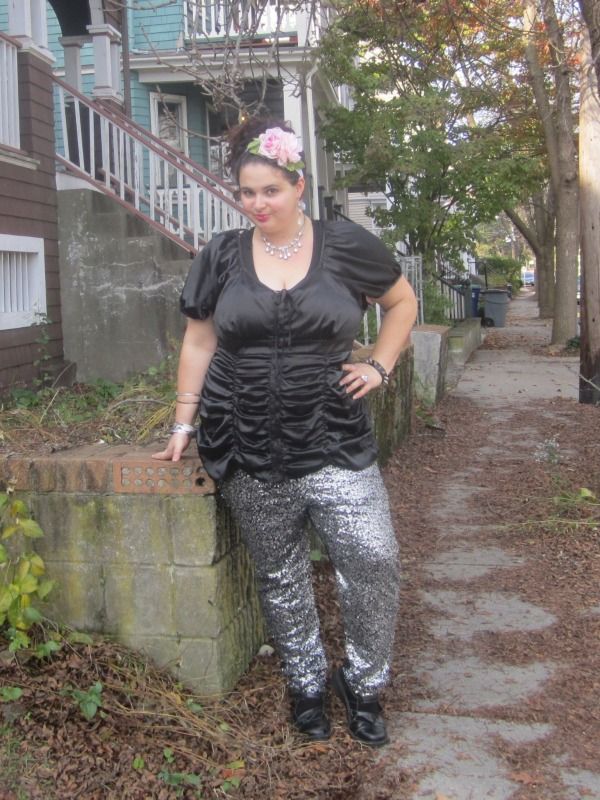
Yeah, I’m wearing leggings as pants. You got a problem with that?
The deeper I get into the fa(t)shion world, the more I come across examples of fashion judging and policing, even within spaces that are explicitly body-positive.
It pisses me off immensely. First, because one person’s style is no one’s business but their own. Period. Second, because it’s inextricably tied up with pretty much every prejudice under the sun: sexism, ableism, ageism, racism, classism, homophobia, transphobia, fatphobia…
Warning: epic rant ahead.
A few examples I’ve come across recently:
1.) Sal at Already Pretty did an interview with three women who dress within a defined aesthetic. I found it interesting, especially since I, like Sal, enjoy dabbling in many different styles. Some days I feel goth, other days pink bubblegum with a touch of fairy kei. Sometimes I just want to be Effie Trinket, or a flapper, or a slightly more sophisticated version of my seventh-grade self (Nirvana t-shirt and wide-leg jeans represent!). And my favorite outfits tend to involve combining multiple styles. So it’s cool to read about people who approach fashion differently.
But this statement, from Candice of Super Kawaii Mama, set my teeth on edge:
And the other thing that I feel very strongly about is raising the bar for the next generation. As a society we have never been so well off (historically) or had such ready and cheap access to good clothing and beauty options. We spend billions on advertising in these markets, spend our pay-checks on magazines of celebrities looking fantastic, and yet never as a nation have we been so poorly dressed / presented. It is a maddening irony and one that will only change if people are brave enough to challenge that status quo and raise that bar.
ARGHHHH NO. Just no.
I like glamour. I really do. But it’s only fun when it’s optional. Sometimes I don’t need or want to be glamorous–like when I’m on my way to go hiking, or sick, or dealing with shitty New England weather, or just in a yoga-pants-and-T-shirt-and-no-makeup mood. I don’t expect anyone else to prioritize glamour or any other aesthetic, or to justify their clothing choices to me.
And I certainly don’t define bravery as “dressing in a way that I like.” You want bravery? Try the NYU Hospital nurses who carried ICU infants down nine flights of stairs in the dark, manually providing them with air and ventilation.
If you find other people’s outfits “maddening,” that’s your problem, not theirs. No one has a responsibility to dress in a way that you like. And the very concept of “poorly dressed” is completely arbitrary. One person’s “eww” is another person’s “awesome.” One person’s clashing is another person’s oh my God your coat is so amazing, I almost want to go to England and steal it from you.
Also, just because we’re well-off overall as a society doesn’t mean we don’t have poverty. It doesn’t mean that everyone has access, financial or otherwise, to the clothing they would like to wear.
Especially if they wear plus sizes, and even more so if they wear a size above 22 or 24. Especially if they lack reliable transportation to stores that carry their size, or the money to pay for shipping. Especially if they have a disability that makes getting dressed difficult, or sensory issues that make certain fabrics uncomfortable. Especially if their weight has changed (for intentional reasons, or due to childbirth, aging, medications, post-diet rebound, health problems, stress, etc.), and they haven’t had the time or money to assemble a new wardrobe. Especially if they’re busy and overworked, or un(der)employed and searching for a job–both of which are currently huge problems in the US and many other countries–and don’t have the energy to put into caring about clothing. Or some combination of these things.
As just one example, if you saw me on the street today, you might think, “why is that lady wearing a lovely goth-meets-business-casual outfit with butt-ugly running sneakers?” I hate how these sneakers look too, believe me. But I’m wearing them because I have plantar fasciitis in my left foot, and sneakers are the only footwear that doesn’t exacerbate it. I can’t even wear cute sneakers, like Converses–my feet are both wide and flat, which makes finding shoes that fit nearly impossible. I take what I can get, regardless of whether they fit my style. And if people want to judge me for it, that’s their problem.
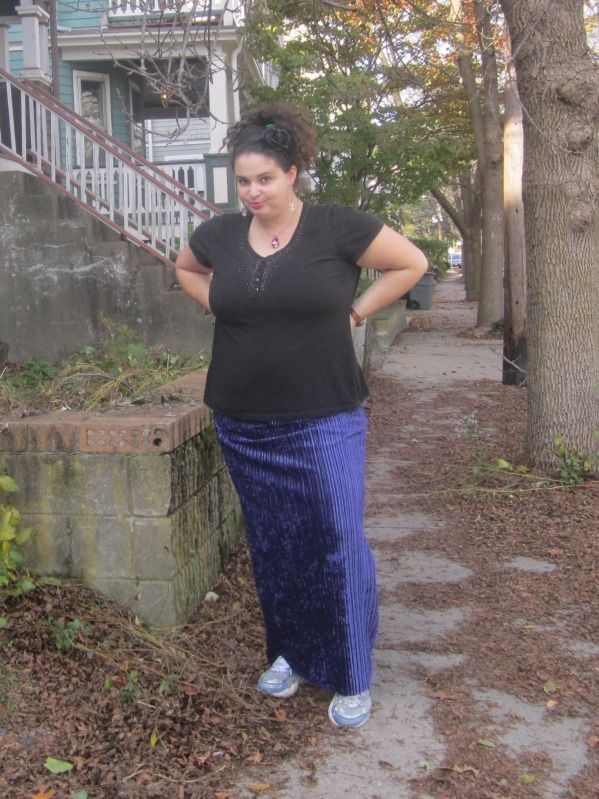
Who knows, maybe I’ll start a trend?
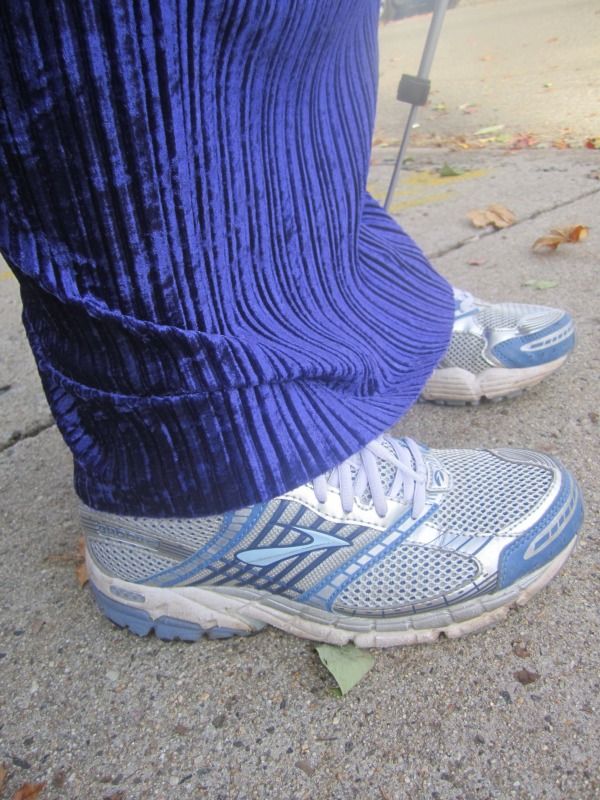
They may not be pretty, but they make my feet less sad.
2.) I don’t normally read MSN Style, or other mainstream fashion sites/magazines/blogs. But I happened to come across this article somehow, and it’s a perfect example of everything I hate about fashion policing.
In the slideshow “8 Fashion Mistakes Men Make,” two fashion “experts” criticize various men’s outfits.
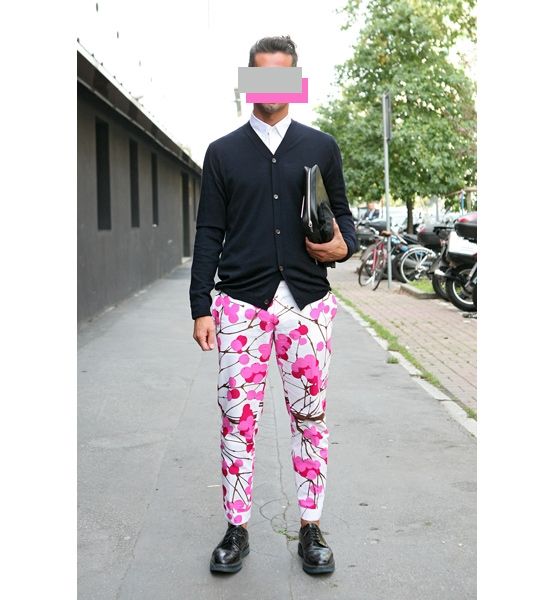
I want to get into this guy’s pants. Literally. They’re just that awesome.
The female “expert” says: “Oh, I see. Those don’t just look like lady’s [sic] capris… they fit like them too. The cardigan, shades and even the black case are so sleek, but the pants need a do-over.”
Maybe they are womens’ capris. So what? Some male-bodied people like to wear women’s clothing. Maybe they’re transgender or genderqueer. Maybe they subscribe to Kate Bornstein‘s philosophy: “I think love, sex and gender are like Pokemon, and I want to catch ‘em all!” Or maybe they just like to wear dresses, like Michael of His Black Dress.
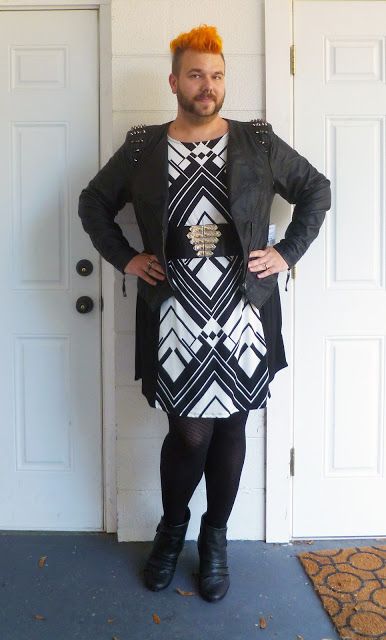
Redefining masculinity, one badass outfit at a time.
The male “expert” says: ”I’m sorry, but I could never take anyone seriously if they walked into a room wearing those pants.”
Fuck that noise.
I doubt it’s a coincidence that gay and transgender people face high rates of workplace discrimination and harassment. Contributing to a culture of gender-policing has real, harmful consequences.
3.) A while back, there was a Fatshionista thread about whether there are age cut-offs for cutesy accessories. The original poster mentioned that she will soon be working in museums, and I think it makes sense to tone down your look for work. But what you wear at work is one thing, and what you wear during your free time is another.
In comment thread, one person said:
If I saw something like this http://virtualneko.files.wordpress.com/2009/01/kawaii-girl1.gif on a person older than 15, I’d judge.

If I saw someone of any age dressed like this, I’d appreciate their awesomeness.
She went on to say:
In my opinion the key is not to look like someone who desperately tries to look way younger than he is.
I hate the assumption that wearing certain clothes or accessories means you’re trying to look younger. I don’t wear Hello Kitty stuff because I want to look younger–I wear it because I like it. I’ll probably still be wearing HK when I’m 80, and I’m ok with that. (Also, I’m kind of looking forward to the day when my hair turns gray/white, because I’ll finally be able to dye it pink without bleaching it first.)
If you like it, and enjoy wearing it, you’re not too old for it. Period.
The same commenter mentioned that she is a huge Dr. Who fan, but limits her fan needs to small pins, socks, and bookmarks. Which is her choice to make, but she’s missing out on some pretty awesome stuff–like the amazing TARDamask shirt one of my coworkers wore recently.
4.) I like Trystan’s blog, CorpGoth, where she writes about keeping a goth edge while dressing appropriately for an office job. So I was disappointed to find two posts in which she makes privileged pronouncements about how people should dress.
In one, she repeats the popular meme that leggings are not pants. Which is so tied up with judgment about women’s bodies–especially fat women’s bodies. With the belief that we need to hide our shapes. With disdain for one of the cheapest and most comfortable clothing options.
In another, she declares:
Let it be known that I am firmly in the camp with those who believe that the casualization of clothing in the U.S. in the late-20th & early-21st centuries is the first step to the downfall of our civilization & that wearing pajamas in public is a sure sign of the coming apocalypse.
I know it’s hyperbole. It’s still not funny.
I feel that people are allowed to wear PJs outside the home exactly three times in their lives: (1) once when you have the flu & need to make a trip to the drugstore for tissues & meds, (2) once when you’re miserably depressed & need chocolate &/or booze between the hours of 2am and 6am, & (3) one additional time to be used judiciously, carefully, not in broad daylight or among more than a dozen people, & it can only last for no more than 10 minutes.
Thanks for deciding what other people are “allowed” to wear. You do know that people have the right to wear whatever they want, right? And that there are a million factors that affect what people wear, and judging them for it is an assholey move?
I could rant more, but instead, here’s a picture of me wearing pajama pants.
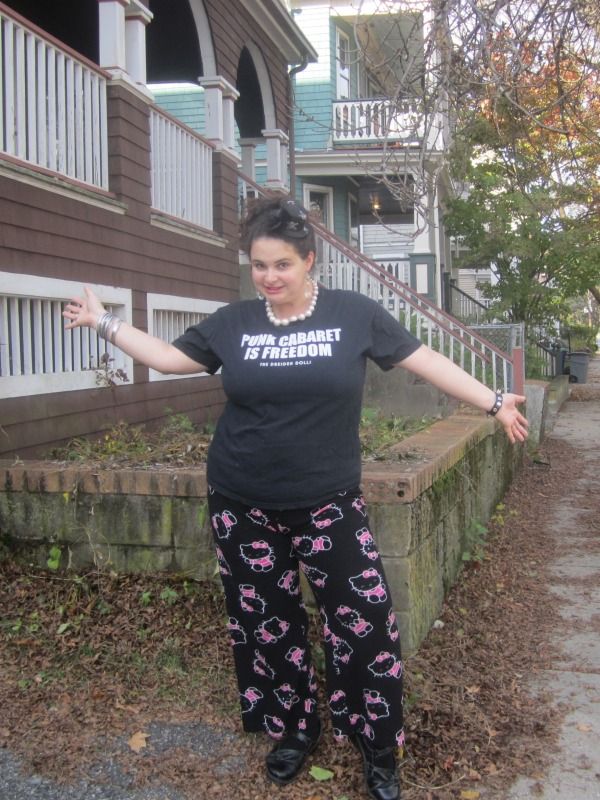
Hello Kitty, of course.
-
I have a phrase I often say: "Believe half of what I say."
The phrase, in and of itself, is partly satirical given that the percentage varies by, and depends on, the situation at hand and that it actually refers to two different phenomenon, thereby being just as convoluted and multi-meaning as the phrases it attempts to explain.
Often it's uttered right after I have just said something which could be construed as possibly insulting. Here, it means to remind that part of my sense of humor is couched in shock. As I'm sure I've explained before, I may use saying something outlandish to underscore how outlandish and devoid of being taken seriously it is. Or, other times just to be absurd. Further, it serves to remind that, whatever I may say about those in my company, I would never actually mean anything disparaging. To do otherwise would be thoroughly out of character for me.
On the other hand, I've often gotten the response to things I say, "Wait, what do you mean by that? This or This?" Both, though not always equally. I couldn't rightly explain to you why people's concerned responses to joking about suicide only serve to tickle me more but it certainly involves that bizarre notion of black humor while simultaneous concern. It moves me in both ways. Likewise, if I sound sarcastic about something, I'm probably highlighting the ironic nature of the matter while trying to seriously make the point of the statement.
The world is rarely firmly black and white; and I've always had a disdain for having to choose.



Recent Comments